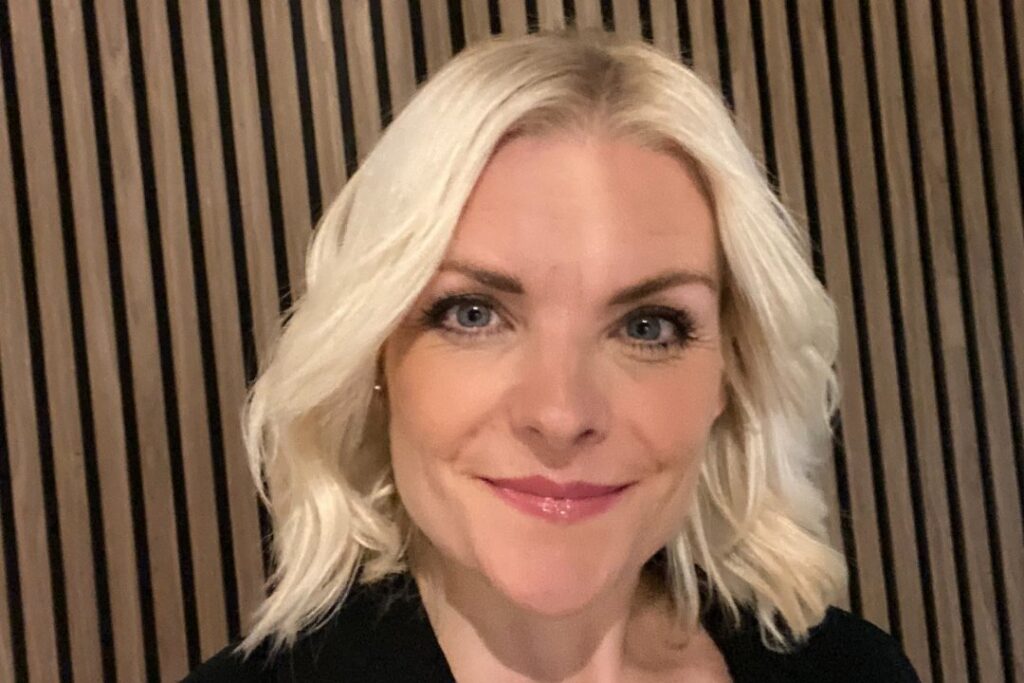
Charlotte, 44, lives in Cumbria with her husband Lee, son Freddy and dog Buddy. After years of trying to manage severe hearing loss with hearing aids, lip reading and coping strategies, she often felt exhausted and left out of everyday life.
Here Charlotte explains how finally being assessed for a cochlear implant transformed her confidence, inclusion and identity.
Discovering my hearing loss
I was about 24 and working for a theatre school when I first found out about my hearing loss.
My sister was working at a high street optician, and they were offering free hearing tests. I went along and I didn’t think anything of it at all. But after the test, the audiologist told me, ‘Your hearing is like that of about a 70-year-old.’
I was absolutely flabbergasted. I’d had no clue whatsoever. I thought they must have got it wrong.
On reflection, that experience was awful. I was given the audiogram and sent on my way. Now I understand my hearing loss, but at the time, I had no clue what was on that audiogram.
Trying to cope and hiding the problem
After the hearing test I thought, ‘Well, I’m fine, I’m working and I’m managing. It can’t be right. ‘ So I just carried on.
But I was working in a noisy environment with children and music and lots going on, and my hearing loss started becoming apparent. Fortunately, my mum was working with me. Over the years, Mum was like an extra layer of security for me. I don’t know how I would have got by without her help.
My mum thought I should get a second opinion on my hearing, but I was in denial for a really long time.”
Motherhood made it impossible to ignore
I realised I needed to do something about my hearing when my son Freddy was born. My husband Lee and I agreed to share feeds so that we could both get blocks of sleep. But I wasn’t waking up and hearing the baby monitor. Lee was exhausted and obviously I felt horrendous – like a really bad mother.
Hearing aids and lip reading
Eventually I went and had NHS hearing aids fitted, but I hated them. They made everything so loud, and gave me chronic headaches. Part of the problem was that I still didn’t understand what was on my audiogram.
I decided to go private. I spent a lot of money getting there, thinking it would be an amazing fix, which it wasn’t. I got a tiny hearing aid and really persevered with it, using it for about five years. But there were no major benefits. I thought, ‘Maybe it’s just like this, and you just have to cope.’
I became a good lip reader. In fact, I once did a lip-reading test and was told I was phenomenal at it. That still makes me laugh, as I’d had no idea how I was doing that. It’s quite a good superpower!
Family life
As Freddy grew up, he was always patient with me. But there were lots of times when I thought I wasn’t a good mum because I couldn’t communicate with him the way I’d have liked to.
In the car, he tried to tell me things about his friends and school, and I’d say, ‘I’m going to have to stop you because I really can’t hear you. You need to wait until I stop in traffic and I can look at you.’ He got very good at coping with that.
Isolation and struggling at work
Lee and I had always been quite social. But because of my hearing loss, I stopped wanting to do things. I didn’t want to meet new people. I just wanted to be in my comfort zone
At work, I didn’t really use the phone, and if I had to, I’d have a massive anxiety attack about it.
Lee says that until I got my cochlear implant, he didn’t realise how bad it had been for me and how much we’d adjusted. That’s just what you do, but over such a long period of time, you don’t realise it.
Cochlear implants sounded ‘too extreme’ – at first
At a routine hearing test in 2021, the audiologist asked if I’d ever looked into getting a cochlear implant. I thought that sounded very extreme. I still didn’t think my hearing loss was that bad.
At my next annual review, a different audiologist mentioned cochlear implant surgery again. I told him I didn’t like the sound of it. What he said to me that day completely changed the course of my life. He said, ‘Why don’t you go and find out what it’s all about? Equip yourself with the knowledge. You’re not going to get surgery the next day. You’re not committed to anything. So why don’t you just see what they say?’
I realised I had nothing to lose by getting referred.
A light bulb moment
I got referred to the James Cook University Hospital in April 2022. The audiologist went through my audiogram thoroughly with me, explaining why I’ve never managed with hearing aids and how I was filling in the gaps.
It was like a light bulb going on in my head. I finally understood my hearing loss. I had some residual hearing of the low frequencies which were in normal range, but I was profoundly deaf with the high frequencies.”
I was told I could get something called a hybrid implant. They would do the cochlear implant surgery and, when I got my processor (the part that is worn externally), they would amplify the high frequencies, which were the sounds that I’d completely lost. Then my residual hearing would fill in, so I’d have a mix of electric and natural sound. But they couldn’t promise to preserve my residual hearing – they would only know about that after the operation.
I came away from that appointment feeling so excited that there was a potential option that I liked the sound of. I thought, ‘This could be life changing.’ The more appointments I went to, I felt the same. I had a million and one questions, and the audiologists were fantastic.
Going ahead with surgery
I was absolutely terrified going into the surgery. I still can’t believe I went through with it.
It’s about a two-to-three-hour operation. My surgeon was thrilled afterwards because he’d managed to preserve my hearing. My audiogram after surgery was the same as before.
I’d done the hard bit. Now I had to heal for four weeks and then I could get on to the exciting bit – the switch on.
Hearing sounds I never knew existed
I went to the switch on with low expectations and high hopes. My mum was with me, and the audiologist asked if I’d like to hear her voice first. I was waiting for this big, emotional moment, but when she spoke, she sounded the same. I will admit that I was a bit underwhelmed. I thought, ‘Is that it?’
It wasn’t until I got in the car to drive home that I noticed the difference. I remember driving away and saying, ‘What the heck is that noise?’ Mum told me it was the car indicator ticking. I was like, ‘I didn’t know my indicators made a noise! That’s amazing!’
Then it started chucking it down and I could hear the rain on the roof. Then an ambulance went past and I could hear the siren. It was just amazing. I was literally driving away from the hospital thinking, ‘I cannot believe it!’
Hearing loved ones and music in a new way

The most emotional thing was coming home and speaking to Freddy, who was 8 years old at the time. I was like, ‘Oh, my little boy! He’s got such amazing diction!’ I just couldn’t believe what a great speaker he was. He was so clear – his enunciation was amazing.
Everyone said that Freddy had probably become a good speaker to help me, and that choked me up so much. Every time he spoke, I felt so emotional. Of all my family and friends, it was his voice that had changed the most for me.
My hearing continued to get better and better and I just threw myself into all the noise. I know some people take it slow and steady and have rests, but I was just like, ‘Give me all the noise!’”
My all-time favourite film is Dirty Dancing and of course my favourite song is the big ending number, The Time of My Life. I wanted to hear that song and for it to be just like I remembered it. When I listened to it, I was absolutely delighted. It sounded even better than I’d imagined, because now I could hear the voices and instruments so much more clearly.
Feeling like a new me
I’ve always said my cochlear implant has been life-changing – but it really does change your identity. It changes who you are. You’ve been living with this thing that makes you work really hard day to day, which is exhausting. And then you suddenly get this second chance. Every day I’m so grateful that I decided to go down that path and have that technology.
In last year, I’ve had a bit of another change because my residual hearing in my implanted side has really dropped. So, I think next time I go for my hearing check, I’ll probably go to full electric sound via my processor (the external part). I’m nervous about the change, but I completely trust the technology and know that with time and effort, my brain will adapt.
Finding support and community with RNID
RNID made me feel that I had support out there, and that there were other people with similar challenges. And that was really comforting for me.
It was the It does matter campaign that inspired me to become an RNID Member. Being an RNID Member and receiving all the news and updates makes me feel like I’m part of something – part of a wider community. That’s massively important to me.”
I’ve shared RNID’s hearing check with loads of family and friends, and they think it’s really good.
Exploring my deaf identity
For 18 years I was in massive denial that I had hearing loss. And even now I think, ‘Do I say I’ve got hearing loss? Do I say that I’m deaf? Am I allowed to say that I’m deaf because I’m not completely deaf? What are the rules?’
There’s a massive spectrum and I don’t ever want to offend anyone or upset any particular communities. All I can do is share my story and hope it will help somebody else – that it may fill in a gap that’s missing for them.
If you’d like to read about Charlotte’s experience of tinnitus, you can find her story in our Your Stories blog.
